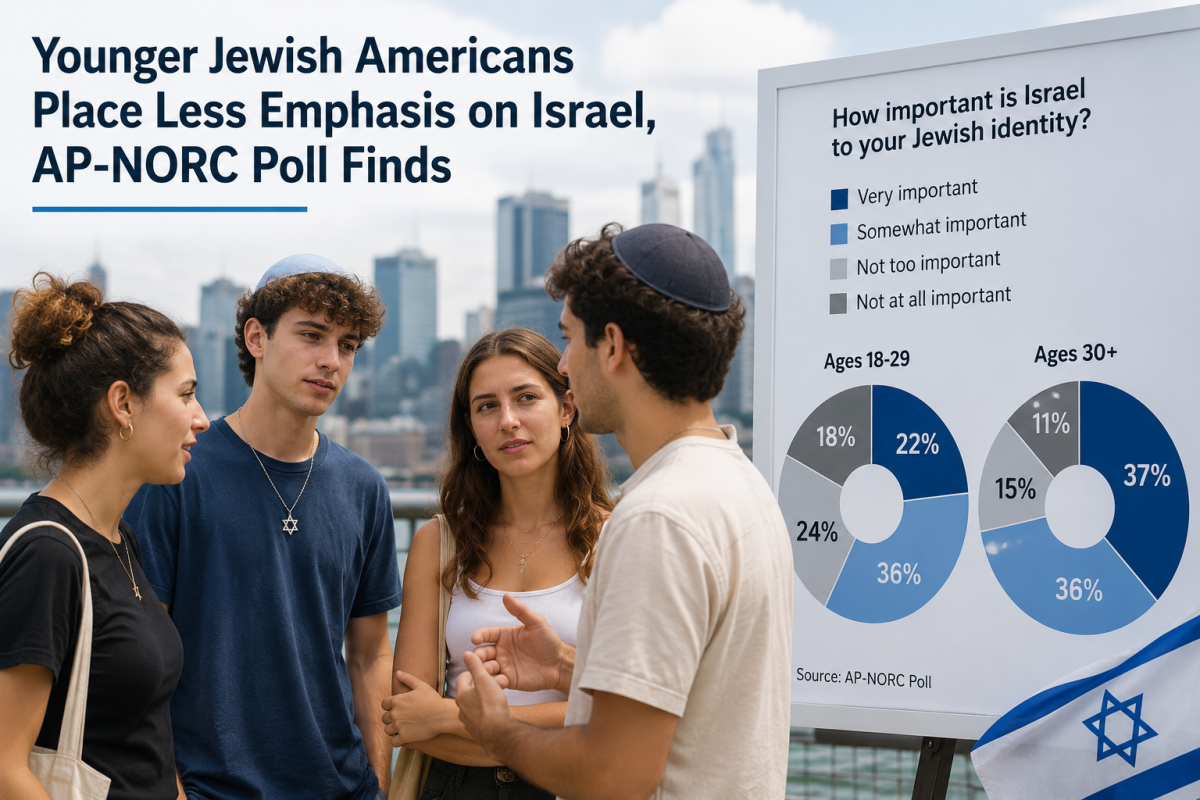
Younger Jewish Americans Place Less Emphasis on Israel, New AP-NORC Poll Finds
A new AP-NORC survey suggests that younger Jewish Americans are redefining what it means to express their Jewish identity, placing less emphasis on support for Israel than older generations while prioritising religious traditions, community, and cultural practices. The findings highlight a growing generational divide that extends beyond politics into questions of faith and identity.
The poll, conducted by The Associated Press-NORC Centre for Public Affairs Research, surveyed 1,022 Jewish adults across the United States and found notable differences in how various age groups view Israel's role in their Jewish identity.
Older and Younger Generations Prioritise Different Connections
Among Jewish adults who identify as religiously Jewish—a group representing about 68% of Jewish adults—roughly six in 10 said being Jewish is either "extremely" or "very" important in their lives regardless of age.
The differences emerge when respondents are asked what aspects of Judaism matter most to their identity.
About half of religious Jewish adults age 45 and older said supporting Israel is highly important to being Jewish, placing it on par with celebrating Jewish holidays.
Among religious Jewish adults under 45, however, only about four in 10 said support for Israel is central to their Jewish identity, while roughly seven in 10 placed greater importance on observing Jewish holidays.
Cultural and Religious Traditions Take Priority
The survey found many younger Jewish Americans remain deeply connected to Judaism, but often through religious practices rather than political or national identity.
Respondents under 45 were more likely than older adults to say that observing Shabbat, celebrating Jewish holidays, and following certain dietary traditions play a significant role in expressing their faith.
The findings suggest that younger generations are reshaping Jewish identity around religious observance and community life rather than primarily around support for Israel.
Views on Israel Reflect Broader Generational Divide
The poll also revealed differences in attitudes toward Israel's military campaign in Gaza following the Hamas-led attack on Oct. 7, 2023.
Among religious Jewish adults under 45, about three in 10 said they believe Israel has committed genocide during the conflict—a claim the Israeli government strongly rejects.
That compares with roughly two in 10 Jewish adults ages 45 and older who share the same view.
The results indicate that debates surrounding Israel increasingly intersect with questions of religious identity for younger American Jews.
Many Older Jewish Americans Continue to View Israel as Essential
For many older respondents, support for Israel remains closely tied to Jewish history and security.
Some participants described Israel as an essential homeland and a safeguard against future persecution, particularly as concerns about antisemitism continue to grow in the United States and elsewhere.
Those respondents said supporting Israel does not necessarily mean agreeing with every government policy but reflects a broader commitment to the country's existence and the safety of Jewish people worldwide.
Younger Adults Express More Diverse Perspectives
Many younger respondents said their connection to Judaism centres on values such as social justice, community service, and opposing oppression.
Some also expressed discomfort with the idea that support for Israel should be viewed as a defining measure of Jewish identity, saying they distinguish between their religious beliefs and their opinions about Israeli government policies.
The survey suggests those perspectives are contributing to a broader shift in how younger Jewish Americans define their place within the Jewish community.
Poll Highlights Evolving Jewish Identity in the U.S.
The AP-NORC poll underscores how American Jewish identity continues to evolve across generations.
While religious commitment remains strong among many respondents regardless of age, younger Jewish Americans appear more likely to emphasise faith traditions, cultural practices, and community involvement over political connections to Israel.
Researchers say the findings illustrate an ongoing generational shift that reflects changing experiences, priorities, and perspectives within one of the nation's most diverse religious communities.