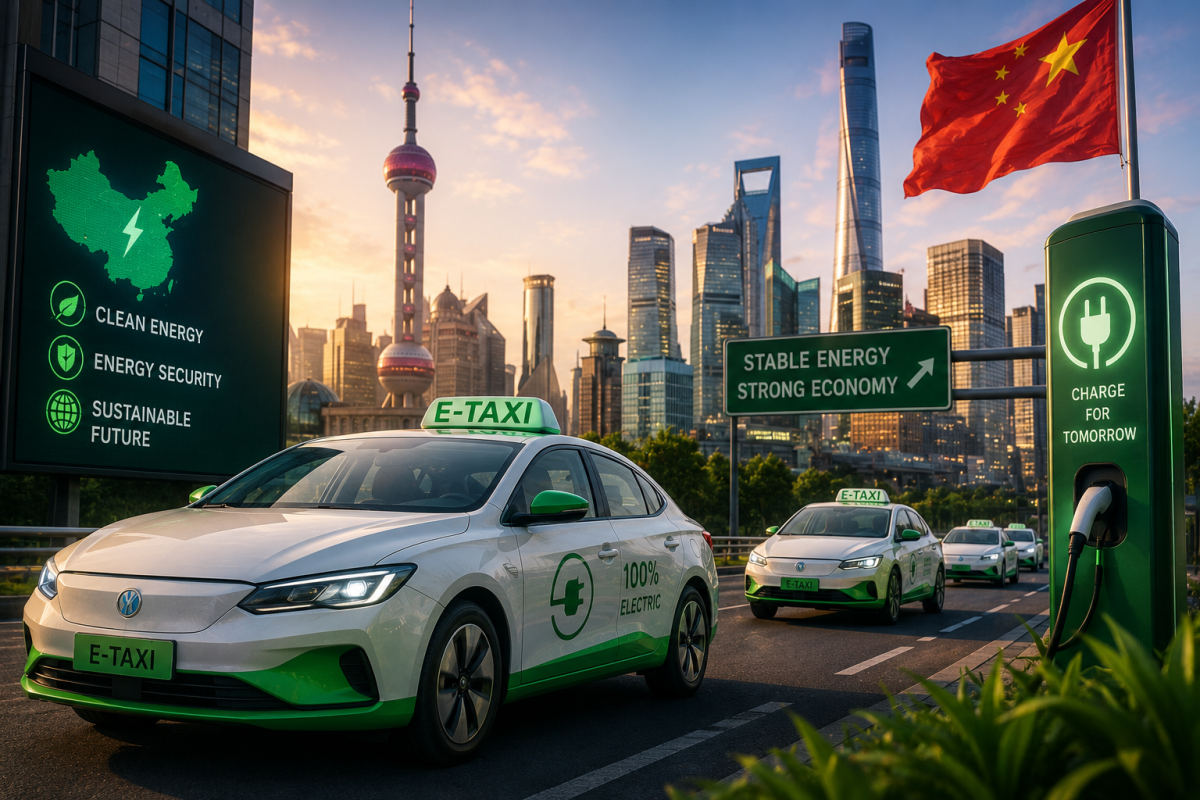
China Turns to Electric Taxis to Cushion Impact of Rising Oil Prices Amid Hormuz Tensions
China's rapidly expanding fleet of electric taxis and ride-hailing vehicles is helping shield the world's second-largest economy from rising oil prices triggered by tensions around the Strait of Hormuz. As fuel costs climbed following the Iran conflict, millions of Chinese commuters shifted toward affordable electric-powered taxis, reducing gasoline demand and easing pressure on oil imports.
Electric Taxis Help Offset Higher Fuel Prices
China's taxi and ride-hailing market has become an unexpected buffer against global energy shocks.

Government data shows passengers made 3.05 billion taxi and ride-hailing trips in May, marking a 6% increase compared with the same period last year after the conflict involving Iran began in late February.
Unlike private vehicle owners facing higher gasoline costs, many commuters found taxi fares becoming cheaper as competition among drivers intensified.

Falling Taxi Fares Attract More Passengers
Industry analysts say several factors are driving the trend.
A slowing economy has encouraged more people to work as ride-hailing drivers, while the growing availability of affordable electric vehicles has lowered operating costs. The increased supply of drivers has pushed fares down even as fuel prices have risen.

A part-time ride-hailing driver in Beijing told Reuters that fares have fallen by 10% to 15% since he started driving six months ago because of fierce competition.
Many commuters now find taking a taxi more economical than driving their own gasoline-powered cars.

One Beijing car owner said she increasingly chooses taxis for longer trips because they eliminate fuel expenses and parking costs.
China's Taxi Fleet Is Becoming Almost Fully Electric
The country's transition toward electric transportation has accelerated in recent years.

According to China's Ministry of Transport:
- About half of the country's 1.3 million taxis are now fully electric.
- In many major cities, the proportion of electric taxis is approaching 100%.
Ride-hailing giant Didi also reported adding another 2 million electric and hybrid vehicles last year, bringing its non-fossil-fuel fleet to 8 million vehicles.
The company says electric vehicles now account for 75% of all ride-hailing mileage on its platform.
Oil Consumption Continues to Decline
China's growing reliance on electric transportation is having a measurable impact on fuel demand.
Compared with a year earlier:
- Gasoline consumption fell 10% in May.
- Diesel demand dropped 14%.
These declines came despite increases in both road freight activity and holiday travel, highlighting how vehicle electrification is reducing oil dependence.
Environmental organization Greenpeace expects 90% of taxi and ride-hailing mileage in China to be electric by 2035.
Lower Oil Imports Ease Pressure on Global Markets
Reduced domestic fuel consumption has also allowed China to cut crude oil imports significantly.
According to Reuters:
- China's oil imports fell 41% year-over-year in June.
By relying less on imported oil rather than drawing heavily from strategic reserves, China has helped free additional crude supplies for international markets during a period of geopolitical uncertainty.
Analysts say this may have contributed to limiting even larger increases in global oil prices.
Analysts See a Long-Term Structural Shift
Energy experts believe recent geopolitical tensions have accelerated changes that were already underway.
J.P. Morgan analyst Natasha Kaneva said the Iran conflict may have reinforced China's long-term transition away from oil, making the economy structurally less dependent on petroleum than previously assumed.
The bank forecasts that gasoline demand will continue declining in 2027, although at a slower pace than this year.
Drivers Continue to Adapt to Fuel Prices
Chinese motorists are also changing their behavior.
Owners of hybrid vehicles increasingly switch to battery mode when gasoline prices rise and refill their tanks only after fuel costs decline.
The combination of electric taxis, expanding EV adoption, and changing consumer habits is giving China greater resilience against global oil market disruptions while accelerating its broader transition toward cleaner transportation.