AMD to Acquire AI Chip Startup Taalas to Boost AI Inference Ambitions
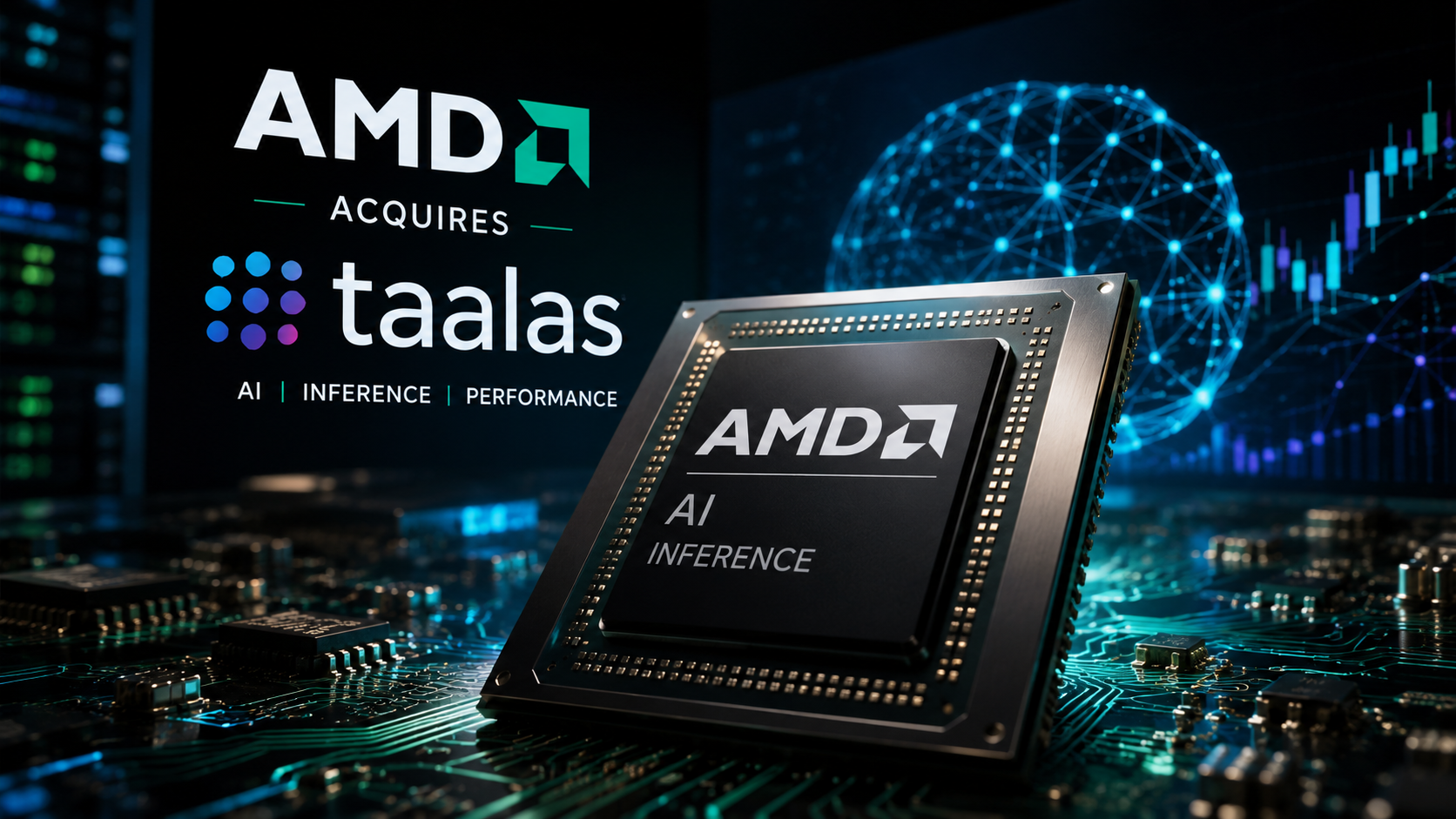
AMD has agreed to acquire Toronto-based AI chip startup Taalas in a move aimed at strengthening its position in the fast-growing AI inference market. The financial terms of the deal were not disclosed, and the acquisition is expected to close in the fourth quarter of 2026, subject to regulatory approvals.
Summary: AMD is buying Taalas to expand its AI hardware portfolio with specialized inference chips designed to run AI models faster and more efficiently than traditional GPU-based systems.
Why Is AMD Buying Taalas?
As the AI industry shifts from training large language models to deploying them at scale, inference has become a major battleground for chipmakers.
AMD believes Taalas' technology can reduce inference costs while delivering faster response times for AI assistants and autonomous AI agents. The acquisition also strengthens AMD's effort to compete more directly with Nvidia in enterprise AI infrastructure.
Founded in 2023, Taalas develops Model-Specific Integrated Circuits (MSICs)—chips designed for individual AI models rather than general-purpose computing.
What Makes Taalas Different?
Unlike conventional GPUs that repeatedly load AI model weights from high-bandwidth memory (HBM), Taalas embeds those weights directly into silicon.
The architecture combines a mask-ROM recall fabric, which stores model weights, with an SRAM recall fabric for key-value cache and fine-tuning adapters. By eliminating much of the memory transfer process, the design significantly reduces one of the biggest bottlenecks in AI inference.
According to Taalas, its first demonstration chip, HC1, built on TSMC's 6nm process, achieved:
-
Up to 16,960 tokens per second running Meta's Llama 3.1 8B model.
-
Around 48 times faster inference than Nvidia GPUs available during testing.
-
Approximately 8.5 times faster than Cerebras accelerators.
How Will AMD Use the Technology?
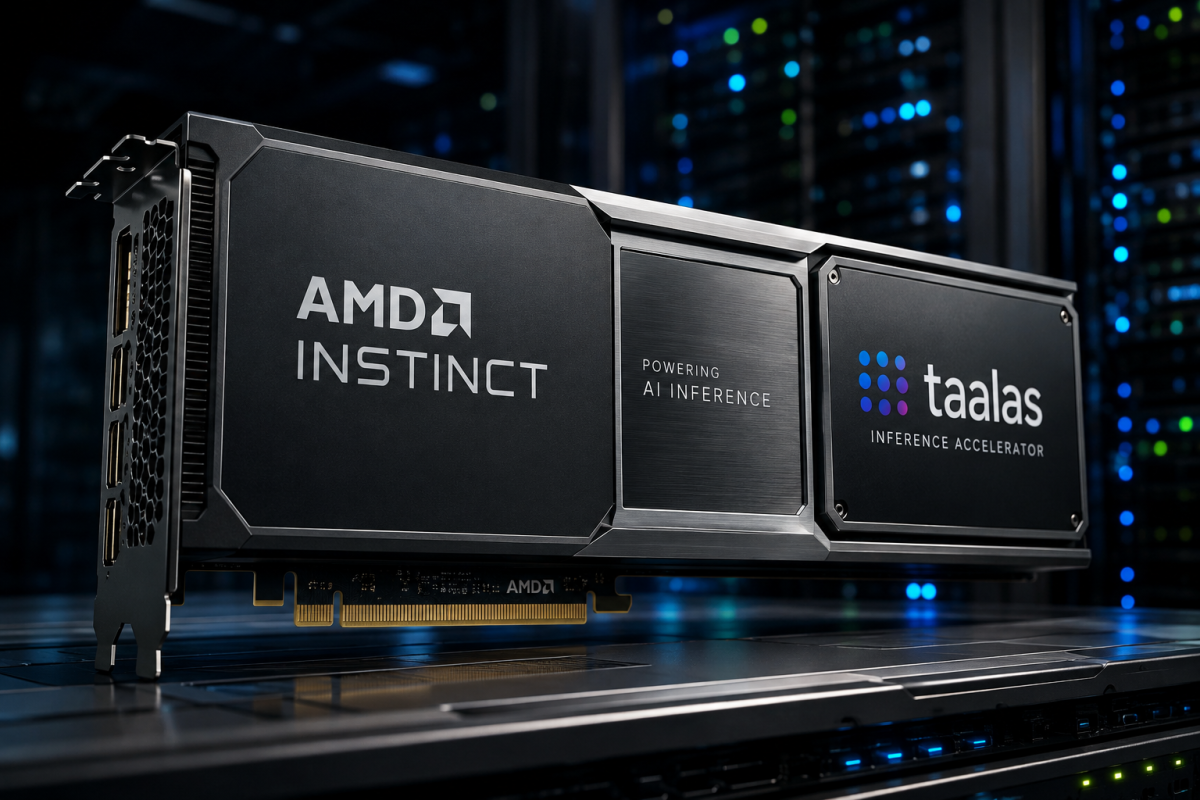
AMD plans to integrate Taalas into its Instinct accelerator roadmap.
Future AI systems could pair AMD Instinct GPUs with Taalas inference accelerators, allowing GPUs to handle compute-intensive prompt processing while Taalas chips generate tokens at much higher speeds.
Direct Answer: AMD intends to use Taalas' specialized inference chips alongside its Instinct GPUs to build more efficient AI platforms capable of handling different AI workloads.
Performance Comes With a Trade-Off
Taalas' approach is highly optimized but less flexible than traditional GPUs.
Because model weights are permanently embedded into the chip, significant AI model updates require a chip redesign. However, the company says most updates involve changing only two metal layers, reducing both redesign costs and manufacturing time compared with creating an entirely new processor.
The upcoming HC2 accelerator is expected to support models with up to 20 billion parameters on a single chip, while much larger models can be distributed across multiple accelerators using pipeline parallelism.
AMD Continues Expanding Its AI Portfolio
The Taalas acquisition is the latest in a series of AMD investments in AI technology. The company has previously acquired MK1, MEXT, and FastFlowLM to strengthen its software and inference capabilities.
Before agreeing to the acquisition, Taalas had raised approximately $219 million in funding, including $169 million announced in February 2026 to accelerate development of its AI inference chips.
As AI adoption continues to shift toward real-world deployment, AMD is betting that specialized inference hardware will become just as important as powerful GPUs in the next phase of the AI chip race.