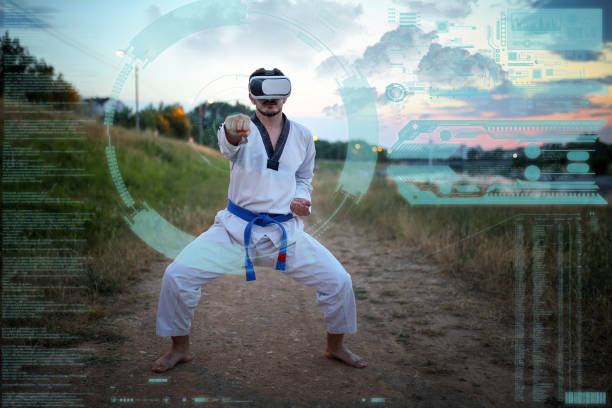
Virtual Taekwondo Gains Momentum as VR and Gaming Transform the Martial Art
Virtual reality is reshaping taekwondo, turning the traditional martial art into a fast-growing digital sport that combines physical fitness with immersive gaming. Once viewed as an experimental concept, virtual taekwondo is now attracting athletes across Southeast Asia and is set to debut at the Asian Games later this year.
The sport allows competitors to fight in a virtual arena using VR headsets and motion-tracking sensors, creating non-contact matches that reward speed, precision and strategy rather than physical impact.
Growing participation among young athletes, families and national federations has positioned virtual taekwondo as one of the fastest-evolving disciplines in competitive esports and martial arts.
How does virtual taekwondo work?
Virtual taekwondo blends traditional kicking techniques with virtual reality technology.
Athletes wear VR headsets along with motion-tracking sensors attached to their spine, thighs and shins. Their movements control digital avatars inside a three-dimensional arena, where competitors score points by landing fast, accurately timed kicks that reduce an opponent's virtual health bar.
Unlike traditional taekwondo, competitors are not divided by age, weight or gender, allowing everyone to compete on equal terms in the same virtual environment.
The discipline was jointly developed by World Taekwondo and Singapore-based technology company Refract Technologies.
Why is the sport becoming more popular?
Virtual taekwondo appeals to younger athletes by combining competitive gaming with full-body exercise.
Vietnamese athlete Nguyen Thanh Hien Linh admitted she struggled during her first virtual competition in Singapore in 2024 because she did not understand how the technology worked.
She said:
"I was just kicking into the air."
Two years later, Nguyen captured a gold medal at a virtual taekwondo competition in Malaysia after learning that success depends on anticipation, movement and tactical awareness rather than simply throwing kicks.
She explained:
"You have to guess first where your opponent is and move."
The discipline was first showcased during Olympic Esports Week in Singapore in 2023 before hosting its inaugural World Championships in 2024.
It will make its Asian Games debut in Japan this year and is expected to feature at the 2027 Southeast Asian Games in Malaysia.
Why are coaches embracing virtual taekwondo?
Coaches say the sport offers the physical benefits of martial arts while significantly reducing the risk of injury.
Singapore national athlete and coach Brian Peh began competing alongside his son out of curiosity and has since started teaching virtual taekwondo at his training hall.
He said:
"I always tell parents: your kids love games. Do you want them using their hands to play, or using their legs?"
Peh added:
"When they put on the headset and start to fight, wow, their energy is so high. They can play and play, and they love it."
Cambodian coach Vandy Yiv said more families are choosing virtual taekwondo because children can compete without the physical contact associated with traditional sparring.
He said:
"Your whole body is moving. There is action, but no injury."
Yiv also expressed hope that virtual taekwondo could eventually become an Olympic medal event.
What skills are needed to succeed?
Although competitions take place in a virtual environment, athletes still require strong physical conditioning and technical ability.
Malaysian coach Henry Lee said endurance, flexibility and speed remain essential to success.
He explained:
"So our training is first stamina, muscle endurance, and flexibility. Then we go toward the skills, the strategies, how to fight."
Lee added:
"Strength ... is about how fast your leg can lift and strike. Speed becomes your power."
Players must also develop spatial awareness, timing and quick decision-making to succeed inside the virtual arena.
Twelve-year-old athlete Victoria Siow said:
"You have to work on your mind — when to kick, how far to move."
She added:
"It feels like a game and like a dream at the same time."
How is virtual taekwondo expanding opportunities?
Supporters say virtual taekwondo allows athletes of different ages, genders and physical abilities to compete on equal terms.
Malaysian athlete Raja Mardiah Idris believes the discipline creates opportunities that traditional sparring cannot always provide.
She said:
"When you wear the VR, everybody is the same."
Raja plans to step away from full-contact taekwondo and focus entirely on the virtual discipline as she aims to represent Malaysia at next year's Southeast Asian Games.
Malaysia's national virtual taekwondo coach, Tony Lee, believes the sport has significant growth potential despite the high cost of equipment.
He said:
"Virtual taekwondo is our future because young people like gaming."
Malaysia has already introduced national training programs and coaching certification courses to support the sport's development.
Questions About Virtual Taekwondo
What is virtual taekwondo?
Virtual taekwondo is a non-contact version of the martial art that combines traditional kicking techniques with virtual reality technology and motion-tracking sensors.
How is it different from traditional taekwondo?
Unlike traditional competition, virtual taekwondo allows athletes of all ages, weights and genders to compete together in a digital arena where speed, timing and strategy determine the outcome.
Will virtual taekwondo be part of major sporting events?
Yes. The sport is scheduled to debut at the Asian Games this year and is expected to be included in the 2027 Southeast Asian Games in Malaysia.
Is virtual taekwondo physically demanding?
Yes. Coaches say athletes still require stamina, flexibility, muscle endurance and fast reactions despite the matches taking place in a virtual environment.
Virtual taekwondo is quickly evolving from a niche experiment into an organised international discipline. As technology continues to reshape competitive sports, its blend of gaming and athletic performance could attract a new generation of martial artists while expanding opportunities for competitors around the world.